More about Geometric Sculptures
Geometrics are mathematical constructions, made:
- by cuts and folds
- in 2D sheets of materials such as:
- cardboard, foil-backed plastic, aluminium foil and thicker non-ferrous metals
- with no waste
… yielding attractive shapes and designs.
The first “Geometric” was made by Arieh Sharon, a famous architect, in the course given by Josef Albers at the Bauhaus in 1927. It inspired me to make my first when I was a teenager. Especially at various crisis points in my life (dropping out of a Ph D course, recovering from a psychotic episode, and dealing with redundancy) I developed them further. The most prestigious installation is a pair, Reflexion and Relief, permanently installed in the lobby of the Garden Quadrangle building at St. John’s College, Oxford. I am grateful to the college, and Denis Moriarty, manager of the Art and Architecture Project, for their support.
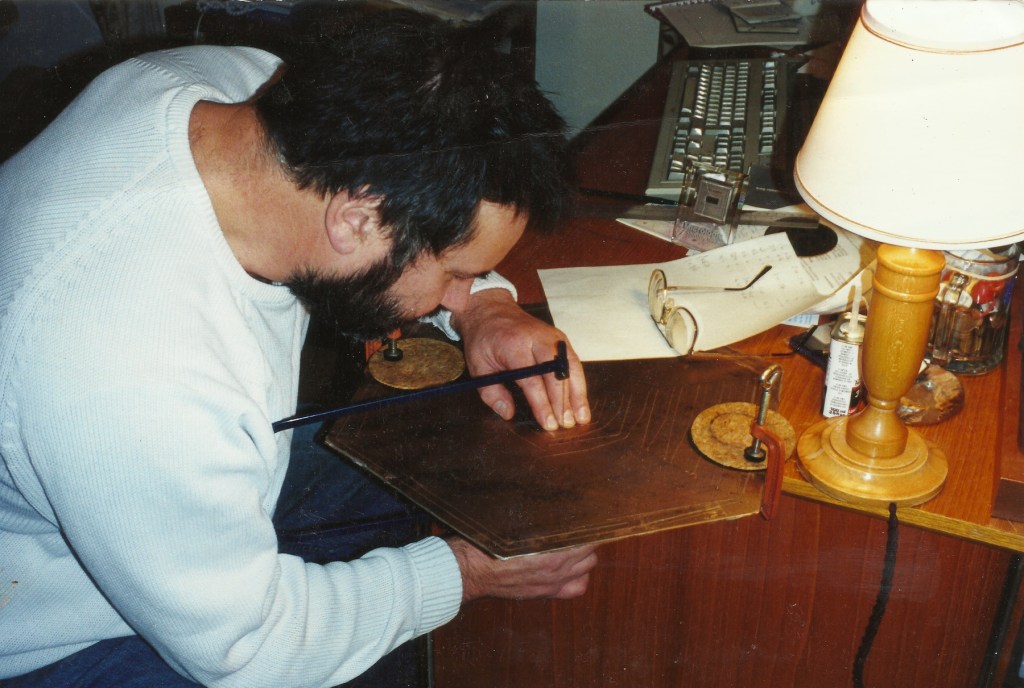
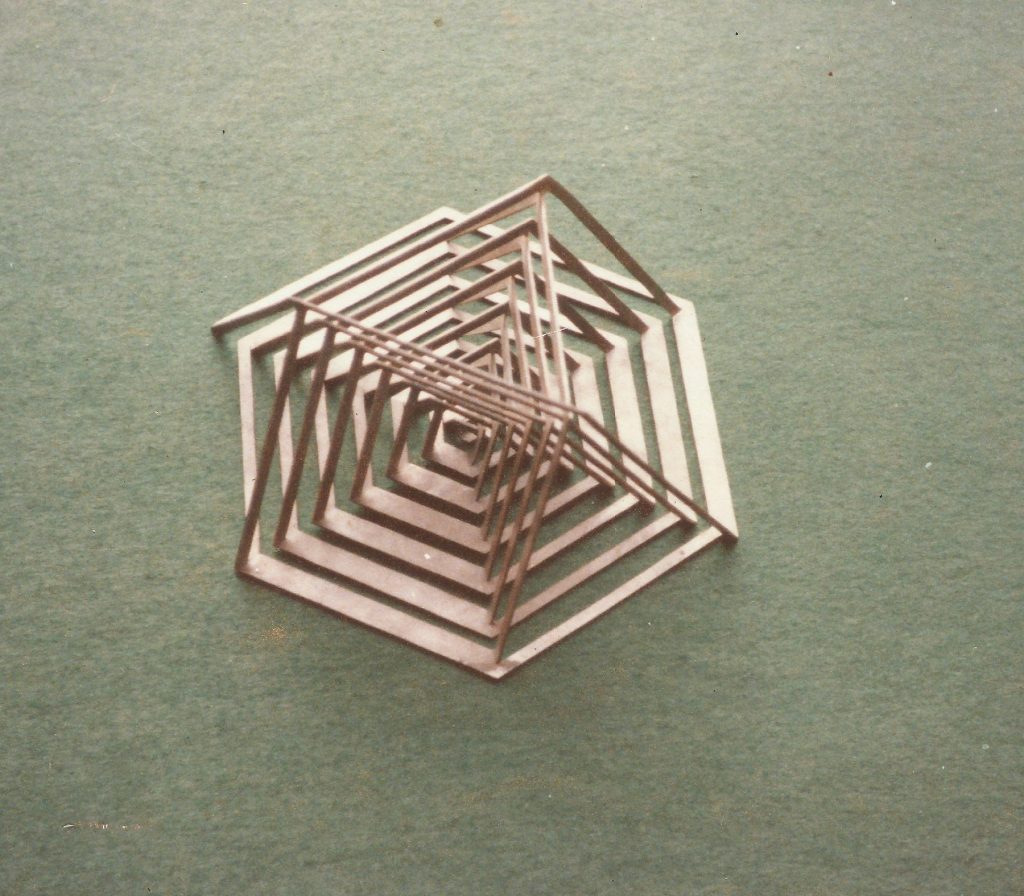
Geometrics have been extended to make shapes by twisting, and I intend to render the designs using a 3D printer. They also inspired my creation of the “Belfonte” water spirals, when Freda Mansfield said “I’d like to see your sculptures with water trickling down them.”
So far, almost all the designs in the family belong to 3 groups:
One-sided group – Strips cut and folded on one side of a flat base, e.g. RELIEF
Two-sided group – Strips cut and folded on both sides of a flat base
Spiral group – Strips cut and projecting from a folded base, e.g. REFLEXION
The one-sided constructions are usually placed on a horizontal surface or mounted on a vertical surface. The two-sided constructions are usually suspended from a ceiling; they can be mounted on a pole. The spiral constructions are often placed with the folded base on a horizontal or vertical surface. Constructions of the same design or similar designs may be assembled together to make striking combinations. In principle the constructions can be in any size. So far most have been between 8 inches (20 cm) and 2 feet (60 cm) across. Materials used so far have been cardboard, aluminium foil, 16 gauge mild steel, plastic, and non-ferrous metals such as copper, bronze, nickel and brass.
 Digital Foundry