Reflexion & Relief
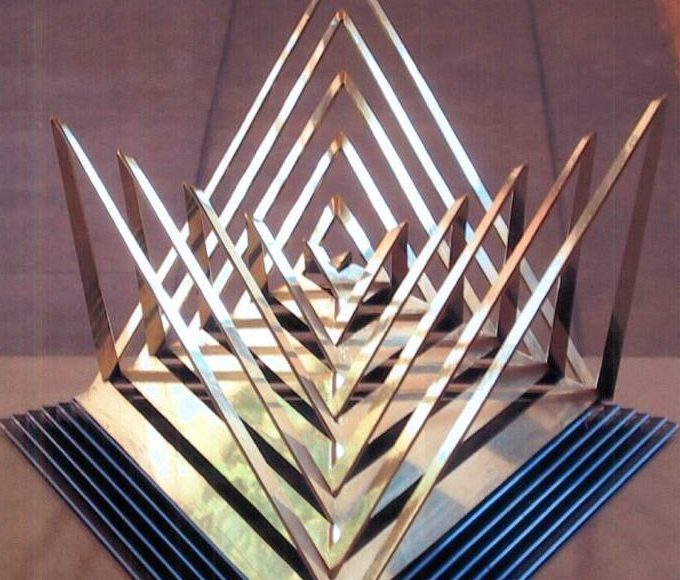
REFLEXION is built from a square sheet by making cuts to form the concentric strips that project outwards and upwards. Folds then raise the projecting strips and form the pyramidal base from double-width strips. The innermost strips are cut square, and consequently have parallel edges. The outer strips taper towards the top to give an effect of fading away from the centre. The extra material released by the tapering is used to provide an overlap along the edges of the pyramidal base. This overlap is used to provide an interlock along the lower edges of the base. The interlock provides complete rigidity for the structure without the use of any brazing, solder or adhesive.
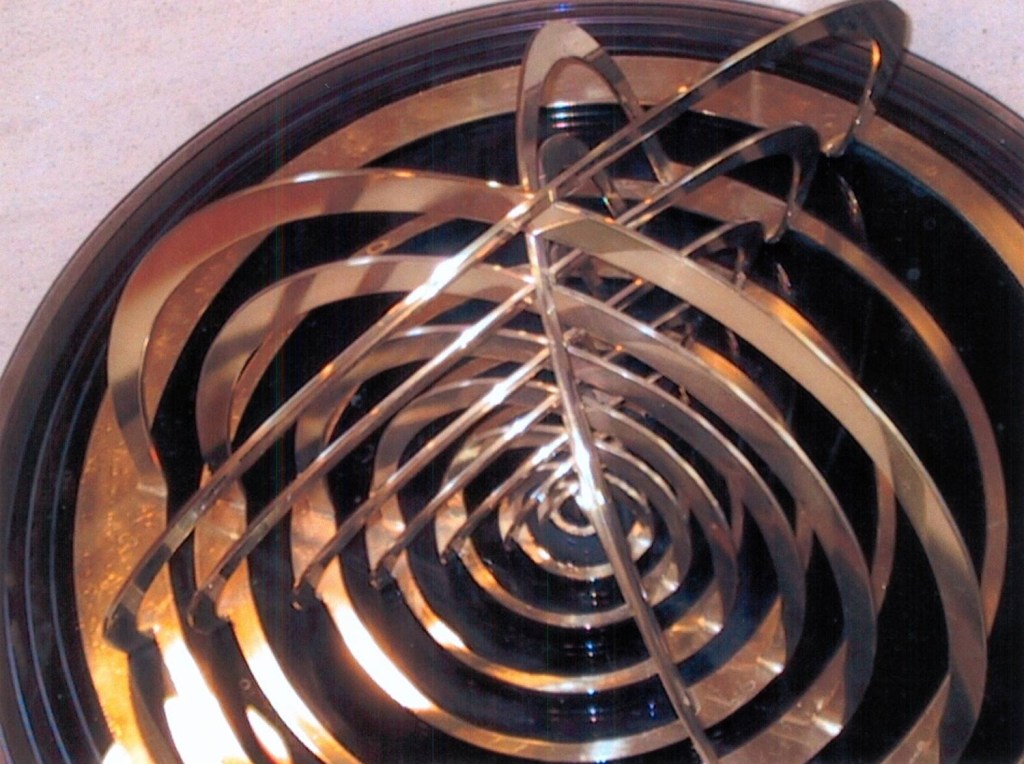
The construction of RELIEF from a circular sheet is more obvious, and is closer to the original Bauhaus concept. Arc-shaped strips are formed by making cuts that are almost complete circles. These circles have centres that have varying offsets from the centre of the original circular sheet. The strips are then folded upwards so that they lean towards the central vertical axis of the disc, touching the 2 neighbouring strips above the centre. The eccentric offsets cause the strips to be wider as they approach their summit, and ensure that contact is made with the adjacent strips.
REFLEXION is formed by making folds in the base whereas RELIEF is formed by folding the strips up from the base. REFLEXION shows what can be achieved by changing foundations instead of building on them. This is how the design for REFLEXION was discovered. It began with a sheet that had been cut to make an old design. The old design folded the strips up from the base. As an experiment the base was folded and a new design was revealed
Looking at REFLEXION and RELIEF
As you examine the sculptures look on them for the reflections of themselves and their surroundings. Look around them for the shadows cast by them and the patterns they make by reflecting surrounding sources of light. You can also see repeated reflections in the layers of glass which form the plinths,
especially reflections of the polished edges. Both sculptures are 3-dimensional forms, each made by generating height from a single 2-dimensional flat
base. The height represents human achievement. In each the cutting of the flat sheet has divided it into a base and strips stemming from the base. The base represents the foundations for human achievement.
RELIEF achieves height by simply folding up the strips from the base. The outermost strips interlock with each other in order to keep them stable. These interlocks need the base to be flexed so that instead of being flat, it rises towards the centre. This shows flexibility in foundations (rules) being used to gain stability in the greatest achievements based on those foundations.
Inspiration from the Bauhaus RELEXION and RELIEF are inspired by 2 exercises undertaken by Arieh Sharon at the Bauhaus School of Design in 1927. The exercises were part of Josef Albers’s preliminary course. This course is described on pages 430-435 of The Bauhaus, by Hans M. Wingler, Seventh printing, published by the MIT Press. The 2 exercises are illustrated on page 433. Paul Fine first saw illustrations of these exercises as a teenager, and at that time constructed similar structures from cardboard.
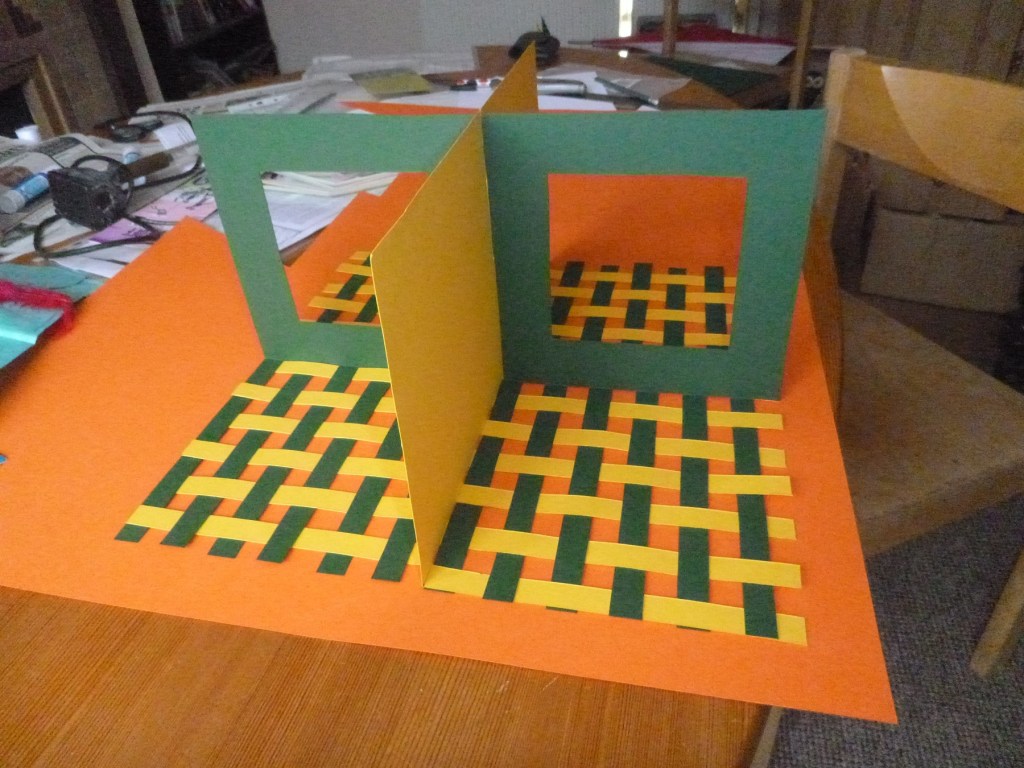
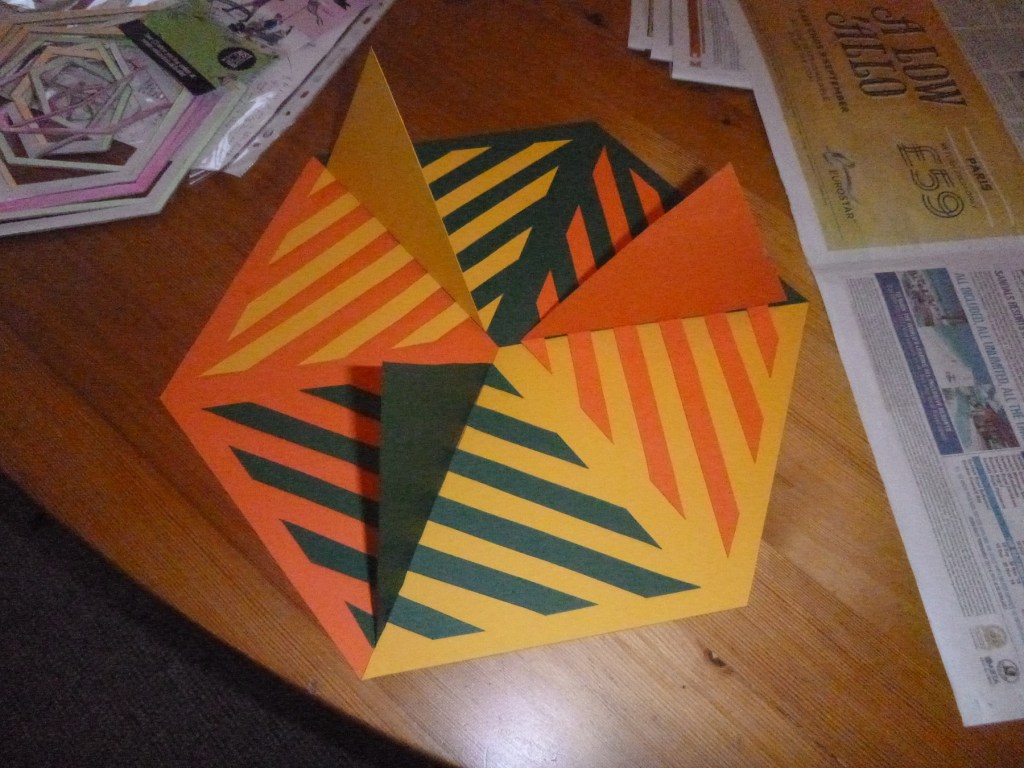
The course included studies in the use of paper, cut without waste, to make 3-dimensional structures. It appears (see page 570 of The Bauhaus) that one of these exercises was reconstructed in sheet metal on a large scale as part of the Bauhaus exhibition in Milan, in 1961. Paul Fine recollects that as a postgraduate student at MIT during 1961-1964, he saw a large scale realisation in sheet metal of one of Arieh Sharon’s 2 exercises at the Carpenter Centre in Cambridge Massachusetts. It was during this period that he realised the conceptual design of REFLEXION, in stiff cardboard.
The principles of constructing 3-dimensional objects from a single sheet, together with the avoidance, or minimisation of waste, underpin Paul Fine’s work today. Examples include the rich family of geometrical sculptures based on the concepts illustrated in REFLEXION and RELIEF, the reuse of offcuts to make mosaic or tiled patterns and the design of complementary representative shapes, following the tradition established by M. C. Escher.
 Digital Foundry